We all know what the Middle Ages looked like. Medieval clothing, in particular, is easy to picture, since we've encountered it everywhere from movies to fairy tales to high school productions of
King Lear. Even as a child I knew hennins, hose, pageboy haircuts, and pointy shoes. This vision of medieval Europe is highly stereotyped, of course, but that's what makes it useful. The medieval setting is a staple of fantasy novels -- it's romantic, it's picturesque, and it gives the modern, western reader a starting point in common with the author. Fashion may have changed substantially during the thousand years between the fall of Rome and the Renaissance, but there seems to be little point in a work of fiction delving too deeply into the subtleties -- even if one describes the clothing in more detail, the reader will either get snagged on strange terminology or end up picturing stereotypical Medieval clothing anyway.
This is not to say that a little bit of education about medieval clothing wouldn't be useful to the writer of speculative fiction, but in a different way than one might imagine. Clothing is never just clothing: it can carry with it a variety of social, economic, and even moral implications. The Middle Ages are foreign enough to our experience that many of their ways of thinking about clothing will be counterintuitive for us. I am going to take you on a small tour of clothing production and of the many roles that clothing played in medieval life. My hope, as always, is that you will find some odd detail that grabs you, something that might not have occurred to you otherwise. The seeds of fiction, in my experience, are almost always facts.
Materials and Manufacturing
As might be expected, wool was by far the most common raw material for medieval clothing. The quality of wool varied widely, depending on the breed of sheep and where it was raised -- British wool was, even then, considered superior due to the cool, wet climate and longer grazing season. Long, fine, white fibers were preferable to short, coarse, dark ones, since they resulted in a finer, stronger thread that could be dyed more brilliantly. Although the exact dates are unknown, the Middle Ages saw the invention of the spinning wheel, the European horizontal loom (other horizontal looms already being in use elsewhere in the world), and the fulling mill, which beat, shrank, and softened wool cloth mechanically.
Wool fabric varied widely in price, depending on the quality of wool used, the hue and darkness of the color, and the process by which it had been woven. The cheapest cloth would have been coarse, scratchy, undyed dark wool, possibly blended with linen or hemp. More expensive fabric would be lighter and finer, could involve a patterned weave instead of a straight basket weave, and would have been softened by fulling. The most expensive woolen fabric would have been nearly as fine as silk. Woad dyed wool various shades of blue or, in combination with other plants, green. The most expensive and prestigious color was red from the kermes insect, and this dye, when combined with a regimen of fulling and clipping, produced the highly luxurious Scarlet cloth (from which "scarlet," the color, derives). Black, which was so popular amongst nobility in the late Middle Ages, was produced not by simply weaving black wool, but by a complicated dying process that made it very expensive, which in turn contributed to its popularity.
We generally associate silks with China, where silk technologies originated. By the time of the Roman Empire, however, silk production had spread all the way to Persia, and it was carried still further in the early Medieval period by Muslims, crossing the north of Africa and into southern Europe. By the thirteenth century, Spain, Italy, and Sicily were producing silks of high enough quality to rival Byzantium's eastern imports. More silk on the market meant it was no longer used exclusively for liturgical purposes. Rich people could actually afford to wear it themselves, and the not-so-rich could sometimes afford a little brocade or ribbon to trim their woolen garments.
It is difficult to gauge how much linen and hemp were used since vegetabld fibers decay so rapidly in Europe's wet climate. It is probably safe to assume, however, that because they were so easy to grow and process, even at the cottage level, they were widely used. Linen does not take dye very well, so most linens were left white. They were worn as head coverings and veils, underclothes, aprons, infant clothes, and work clothes for hot weather.
Europeans associated the wearing of animal skins with paganism and barbarity, so one does not see much leather clothing. Shoes, belts, gloves, artisans' aprons, and armor (or padding for armor) are about the extent of it. Fur became popular for trim or to line the inside of warm garments. The more expensive varieties were frequently a dramatic color: sable, vair, ermine, and miniver (squirrel).
The actual production of clothing took place in many different ways. The most straightforward way was to have your women do everything at home, from wool processing to weaving to sewing. This had been the tradition in classical Greece and Rome, and was continued, particularly in rural households, throughout the Middle Ages. As population centers grew, however, the production of textiles became a centralized industry, and therefore more the domain of men. Weaving and sewing became separate crafts, practiced by separate guilds.
For the wealthy, it would have been most common to employ the services of a tailor and have clothing custom-made. The customer would be responsible for providing the tailor with the fabric, but the tailor would provide the thread. If one wanted fur trim or embroidery, a furrier or embroiderer (each from a different guild) could also be employed. Royal households would have had all these craftsmen on staff, sometimes one per each adult in the household. This is not to say that the art of sewing was lost in wealthy households -- women, and not just servants, would certainly have been engaged in embroidery and lace making, if nothing else, but it is likely that some did repairs and alterations themselves as well.
Surprisingly enough, there was also some ready-made clothing available. Mercers' shops, the medieval answer to the general store, sold a variety of items. Most seem to have been accessories, like gloves, caps, and socks, but some carried simple shifts and hose as well. Tailors would also sometimes have clothing for sale that had been made but not paid for. While this was not exactly department-store convenience, it was still an interesting and unusual development for medieval Europe, where such products usually passed directly from producer to consumer.


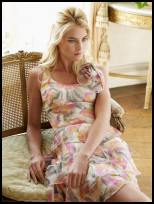

 All manner of styles have appeared for Spring 2009 with both customers and retailers taking the dress to heart. These two dresses above right are by Celine. Both Celine dresses illustrate the fashion trendsetter elements with the loose painted on dye fabric effect, the widening longer line skirt and wider shoulder line.